Start with the charity’s identity. Read its financial reports. Ask what changed for the people it serves. MonkeyCharity helps you organize that research before you give.
This page provides a research checklist and an expense calculator. It does not maintain charity listings, issue ratings, or collect donations.
Write down the legal name, address, and employer identification number (EIN). Compare these details across the appeal, the organization’s website, and its filing. Keep the filing year beside your notes so you can see when the information applies.
The Federal Trade Commission (FTC), in Before Giving to a Charity (2025), advises checking the exact name, website, and address. Similar names can confuse donors. Contact the organization through details you find independently when an appeal raises questions.
Find the official record
The Internal Revenue Service (IRS) provides Tax Exempt Organization Search. It includes eligibility information for deductible contributions, returns, determination letters, and revocation records. Source: IRS search guidance, checked in 2026.
Open the record for the organization you intend to support. Save the document title and reporting period. Treat a missing or unclear result as a question to investigate. Do not substitute a similar name for an exact match.
Charity expense calculator
Enter expenses from the same reporting period and in the same currency. For a completed Form 990 breakdown, use Part IX, line 25: program services in column B, management and general in C, and fundraising in D. Source: IRS Form 990 instructions (2025).
The starting amounts are an illustrative example, not a real charity’s accounts. Replace them with your figures. Enter zero only when the source reports zero; leave an unknown amount blank.
Method: add the entered expenses. Divide each category by that total, then multiply by 100. Percentages use one decimal place, so rounding can affect their sum. Each amount must be between zero and one trillion, with no more than two decimal places. The calculation runs here without a lookup or signup.
These shares describe the entered expenses. They do not measure outcomes or determine how a particular donation will be used. Use them to prepare questions, rather than to assign a charity a score.
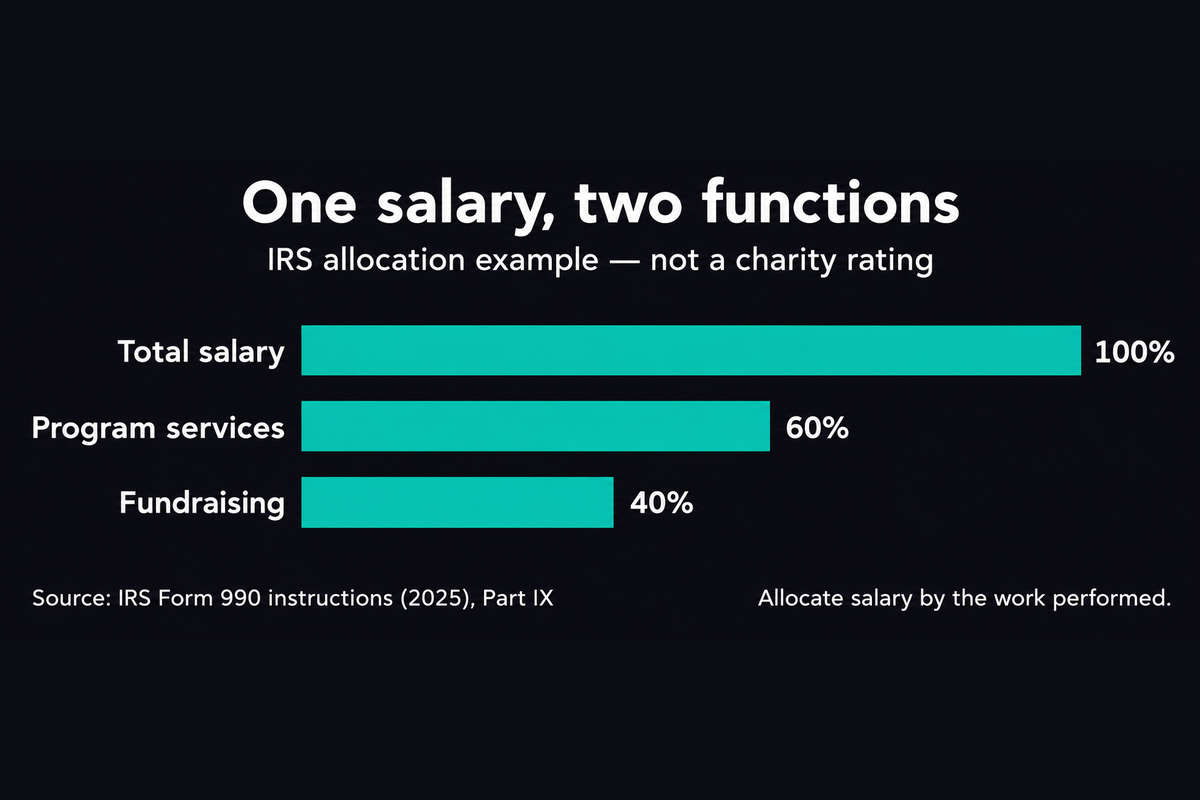
IRS Form 990 instructions (2025), Part IX: split the example salary between program services (60%) and fundraising (40%). The total is 100%.
The IRS example assigns an employee’s salary by time spent on each function. It does not set a target percentage for charities. The chart illustrates allocation, not effectiveness.
Turn financial figures into useful questions
Check the period. Put the reporting period beside each amount. Compare like periods before you describe a change. Keep an older return separate from a current campaign budget.
Check the explanation. Ask which activities the organization includes in each expense category. Request context for changes in staffing, facilities, or fundraising. Record the answer beside the figure rather than guessing from the percentage.
Check the result. Ask what the program seeks to change. Request its definition of success, its measurement method, and the period covered. Keep a count of activities separate from evidence about results.
Use a short research note for each organization: identity, source document, reporting period, expense breakdown, outcome evidence, and unanswered questions. Compare organizations that address the same need. Avoid combining unlike services into a single ranking.
This checklist is an editorial research method. It does not certify organizations. Your notes should show what you know, where you found it, and what still needs an answer.
Review the appeal before you give
The FTC’s 2025 guidance recommends researching a charity’s name with terms such as “complaint” or “scam.” It also advises reviewing payment statements for unexpected recurring donations. Read the program description and check that it answers your questions before you act.
Keep the appeal, your research notes, and any receipt together. Return to your unanswered questions when the organization publishes another report. A useful decision record explains why you chose the program and which evidence influenced your choice.
Sources: IRS, Instructions for Form 990 (2025), Part IX; IRS, Tax Exempt Organization Search (checked 2026); FTC, Before Giving to a Charity (September 2025). This guide focuses on U.S. nonprofit research.